
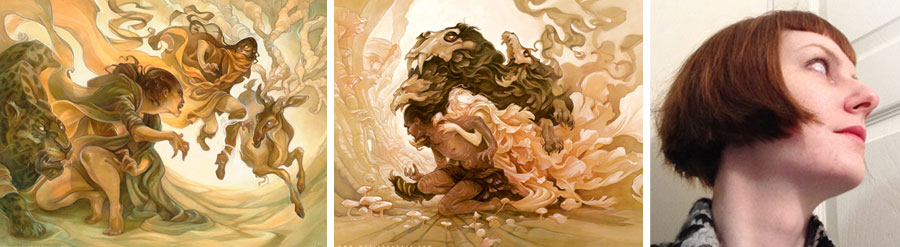
Wylie Beckert is a relatively new face on the genre art scene, and yet has made a very special mark in a short time. Wylie has refined a look that is unmistakably hers and is one of the most prolific artists on the Every Day Original team.
You can find her on Facebook, get lost in her portfolio site, or keep reading for some insight into what makes her tick, why she lives in Maine, and why night after night you can find her at the easel.
1. So wait, you’re new to making original art pieces? When did you start creating fully traditional work? What got you to go full-in on original pieces?
I’d certainly handled traditional media before I got into digital work – but on a pretty basic level. I’ve always been more of a draftsman than a painter, so adding what was essentially digital comic book coloring to my pencil drawings felt more natural than picking up a paintbrush. Late 2013 is when I first dug out some unused oils from college and started trying to learn to paint; it probably took five or six months to get the hang of the basics. I had to do a ton of experimentation before I started to get a similar look to my digital work.
2. How does your digital training inform your traditional work? Was it like starting over or did some lessons transfer?
There was a huge amount of carryover. I started having better luck with painting as soon as I tried to replicate my digital process in traditional media. I already had a pretty good idea of how to go from a pencil drawing to a finished piece—the hard part was figuring out what combination of materials could stand in for the dozens of Multiply, Color, and Screen layers I was used to using in Photoshop.
3. You say you really kicked things off about four years ago, and you’re already moving focus from commercial to personal work. Tell us more about that.
I’ve been consistently frustrated in the search for the right kind of commercial work—I seem to have an oddball style that doesn’t fit in much of anywhere (too whimsical for adult brands, too many skulls for bedtime stories). Devoting time to my personal work is a chance to clarify the direction I want to take and better represent the aesthetic I’m passionate about. I’m optimistic that the new direction will resonate with art directors as well.
4. Why settle in Maine? Does your location influence your art?
I followed a boy here, thinking I’d stay a year or two, only to realize that Maine is a sentient evil that doesn’t want me to leave! While I don’t think the locale has had a major influence on the content of my images, six years of living in relative isolation gave me plenty of reason to buckle down and focus on my art. However, I can finally say with 100% certainty that I’ve spent my last winter in Maine. I’ve got my eye on Seattle next.
5. Do you collect art?
I’m a pretty staunch minimalist, so there isn’t much room for decorative items in my life at the moment. Even my own art is generally taped up in boxes in the closet, safe from coffee spills, waiting for the next convention. I’m always happy when I sell a piece because it means it will finally get to see the light.
6. You have a really solid online following. Do you have “True Fans”? How do you engage with them?
I like to think some are True Fans! I’ve got a few loyal followers who’ve consistently picked up the prints and originals I’ve had on offer. Regarding social media, a huge percentage of my fanbase seems to be made up of artists. I always feel a little guilty for not engaging more; my social media negligence is almost always the result of working hard to produce more art for them to look at!
7. Why do people collect your work?
I’d say the two things that draw people are the sense of movement—flowing, decorative shapes and elegant lines—and the emphasis on character and storytelling. I also believe that because I’m so new to traditional media, each new piece represents its own separate moment in time, completely different from past and future work as my process changes.
8. Do you have other passions other than art? What has the power to drag you away from the easel?
My favorite non-art-related hobby is “reading”—listening to audiobooks while I paint. My other hobby is sitting in a stupor with earbuds in and a blindfold on, listening to music. On the rare occasions that Maine weather allows, I also enjoy running.
9. Can you walk us through the process from a specific source of inspiration to a finished piece?
Take the King of Spades from my Wicked Kingdom series. I focused on the reversible composition and created a character with dual identities. The Spade symbol made me think of botanists or gardeners. Why would a king be a gardener? Because he let his kingdom fall to care for his plants. Parallels led me to the other half: a gravedigger. I visualize the layout with rough thumbnails to establish a value structure, then move to the final drawing and painting.
10. Why enroll in art courses like SmArt School or IMC when your art is already so refined?
There have been various points where I was okay with my art, but then got a slight push and realized how much better it could be. Once you’ve reached a level that represents your self-directed “best,” it can be hard to know where to go next or spot areas for improvement. Outside instruction has definitely helped me get through that.
11. If you’re already working, what do programs like this do for you?
Interacting with other artists has a significant impact professionally. There’s a lot to be gained by seeing new art, talking shop, and finding out about other people’s methods. Better art definitely equals more jobs. Not to mention how much fun artists are in a group!
12. How do you quantify whether a convention is “worth it?”
I attend Spectrum Live and Illuxcon because people are there for the art. I look at it as self-promotion and a fun social gathering. Financially, I consider the convention worthwhile if I break even with the expense of attending through sales or secured commissions.
13. What do you hope to get out of portfolio reviews from Art Directors?
I’m putting my work out there to reiterate my interest in working with these ADs. I’m still looking for that first commission from WOTC, Tor, or Orbit. I’ve changed quite a bit since my last reviews, so I’m hoping my traditional work is more to the tastes of the brands they represent.
14. Does your Prosopagnosia (face blindness) affect your work?
It took me a long time to grasp drawing faces. I spend a HUGE amount of time on them now—sometimes 8 hours of reworking to get something that looks human or the right age. I always draw the faces first because I know there’s a chance I’ll destroy the paper by over-erasing and have to start over. Faces are such an important part of an image that doing them right isn’t negotiable.
15. How do you respond to the idea that we must relate to others in person to live a complete life?
I’d generally agree; the need for social structure is hardwired. Working from home in a Maine winter makes it easy to become a shut-in. However, focusing on my art for the past few years has been the right move. The skills you acquire—patience and resilience—carry over to all other areas of life and make you a better person.
16. Any final thoughts?
Just to keep an eye out for more art! Everyone on EDO is steadily upping their game.